
Table of Contents
- Why Professional Undercoating for Delivery Fleets Beats Annual Spray Treatments
- Wax-Based Undercoating for Fleet Vehicles: Coating Selection by Use and Material
- Fleet Undercoating Maintenance Schedule and Service Checklist
- Frequently Asked Questions
Last Updated: October 13, 2026
Why Professional Undercoating for Delivery Fleets Beats Annual Spray Treatments
Professional undercoating for delivery fleets is a one-time, wax-based application that seals a vehicle’s undercarriage against road salt, moisture, and de-icing chemicals for years rather than months. Thin seasonal sprays wash away; a properly applied wax coating bonds to the surface and stays put.
Annual treatments mean yearly downtime for every vehicle; a one-time application means one visit and years of protection, for a fifteen-van fleet, fourteen fewer service appointments in year one alone.
The failure point isn’t the coating, it’s the prep. Coating a dirty, damp undercarriage traps moisture and accelerates the corrosion it’s meant to stop.
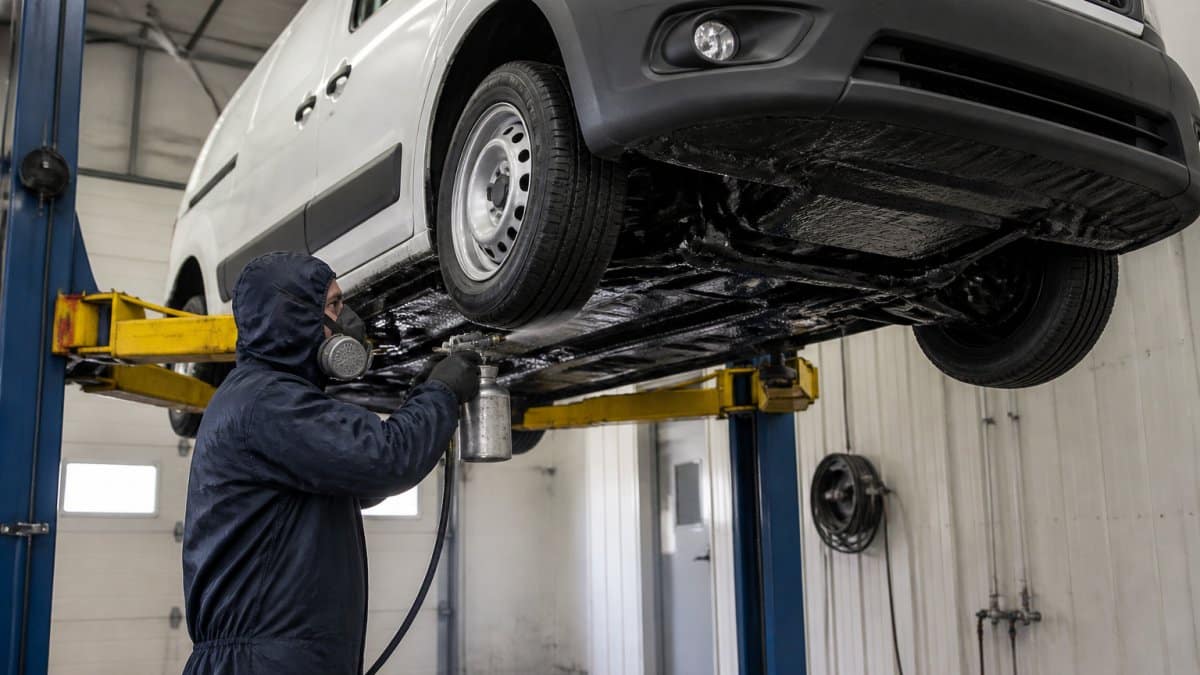
Wax-Based Undercoating for Fleet Vehicles: Coating Selection by Use and Material
Wax-based undercoating for fleet vehicles is the best fit for delivery fleets: it creeps into seams, self-heals around minor abrasions, and resists the salt brine that clings to undercarriages after every winter run. Oil-based coatings wash off faster; rubberized coatings trap moisture and crack under flex.
|
Vehicle Use |
Typical Exposure |
Recommended Coating Approach |
|---|---|---|
|
Local delivery vans |
Daily salted roads, frequent stops |
Wax-based, full undercarriage coverage |
|
Long-haul trucks and trailers |
Highway spray, constant vibration |
Wax-based, flexible film for flex points |
|
Municipal and public works |
Heavy de-icing chemical contact |
Wax-based, high-build on frame rails |
The material underneath matters too: steel frames, aluminum bodies, and factory-coated panels all hold up differently, so we start every fleet job with an inspection rather than a quote.
Fleet Undercoating Maintenance Schedule and Service Checklist
A fleet undercoating maintenance schedule turns a one-time application into a decade of protection. Inspect each fall before the first salting, check high-wear zones like wheel wells, rocker panels, frame rails, and crossmembers, touch up chips and scrapes before winter, and document condition per vehicle.
Frequently Asked Questions
What is the best undercoating for a delivery fleet?
Wax-based undercoating works well for delivery fleets because it stays flexible, resists road salt and deicing chemicals, and holds up through repeated wash cycles. Unlike oil-based sprays that need yearly reapplication, a professional wax-based coating is applied once and cures into a protective film on the chassis, rocker panels, and wheel wells. Fleet managers should confirm the product is designed for commercial use and backed by a written corrosion guarantee.
How often should delivery fleet vehicles be undercoated?
A professional one-time wax-based application typically lasts for years, so annual reapplication is not required. What matters more is a fleet undercoating maintenance schedule that includes periodic inspections, especially before and after winter. Check high-exposure areas like wheel wells, frame rails, and underbody seams for chips or wear. If damage appears, spot repairs extend coverage. Vehicles in heavy salt exposure may benefit from a mid-season inspection.
What should fleet managers look for in an undercoating service?
Look for a provider with commercial fleet experience, proper surface preparation, and thorough coverage of the undercarriage, chassis, and hard-to-reach seams. Ask about the coating type (wax-based vs. oil-based), the warranty for commercial vehicles, and whether the shop can handle your fleet volume without long downtime. A fleet undercoating service checklist should include a pre-inspection, documented coverage areas, and post-application instructions.