Table of Contents
- Why Automotive Undercoating Matters in Rochester
- Is Rustproofing Necessary for New Cars?
- What Gets Treated: A Pre-Application Inspection Checklist
- How Long Does Automotive Undercoating Last?
- Best Practices for Vehicle Corrosion Prevention
- DIY vs Professional Undercoating: What You Need to Know
- How to Book Your Undercoating Appointment
- Frequently Asked Questions
Last Updated: September 28, 2026
Why Automotive Undercoating Matters in Rochester
Automotive undercoating is a protective coating applied to a vehicle’s underside to shield metal components from road salt, moisture, and debris that cause rust. In Rochester, where winters bring heavy road salt and salt brine, that protection can decide whether your vehicle lasts another decade or starts showing frame rust within a few seasons.
How Road Salt and Salt Brine Attack Your Undercarriage
Road salt is the obvious culprit, but salt brine is the sneakier one. Crews spray this liquid solution before storms, and it clings to metal far more aggressively than dry rock salt, seeping into frame rails, suspension mounts, and brake and fuel lines.
The biggest mistake drivers make is waiting until they see rust to get protection. Undercoating works as a preventative measure, not a repair. Once frame rust sets in, no coating stops it completely, since the metal is already compromised from the inside.
Is Rustproofing Necessary for New Cars?
Rustproofing is not required for a new car, but it’s one of the smartest preventative maintenance decisions you can make if you plan to keep the vehicle long-term. Factory coatings protect visible body panels but leave large portions of the undercarriage, subframe, and inner panels exposed, exactly the areas road salt reaches first.
What Gets Treated: A Pre-Application Inspection Checklist
A proper undercoating job starts with a thorough vehicle inspection, not a spray-and-go. Surface preparation determines how well the coating bonds and how long it lasts. Before any product touches your vehicle, a technician should check these areas:
- Frame rails and crossmembers for existing surface rust
- Wheel wells and inner fender liners
- Rocker panels and cab corners
- Brake and fuel lines for corrosion or pitting
- Suspension components and mounting points
- Floor pans and any prior patch work
- Drain holes to confirm they aren’t clogged
- Existing coatings for peeling or flaking
How Long Does Automotive Undercoating Last?
There is no single lifespan number, because longevity depends on three variables: product chemistry, surface preparation quality, and the conditions the vehicle faces. Change any one and the same product can last two seasons or a decade.
Product Chemistry Sets the Ceiling
Undercoating products fall into a few broad families, and each behaves differently under winter exposure:
- Oil-based coatings creep into seams and displace moisture well, but remain soft and gradually wash off.
- Wax-based coatings cure into a firmer, waxy film that resists wash-off and can self-heal minor scuffs. Applied correctly, a wax-based product is designed as a one-time application rather than a seasonal chore.
- Rubberized and asphalt-based coatings dry hard and look tidy, but can crack as the metal flexes, trapping moisture against the steel, the opposite of what you want.
- Factory e-coat and galvanizing protect what they cover, but they stop at the edges of stamped panels and leave subframes, seams, and hardware exposed.
Preparation Determines Whether the Product Ever Gets to Work
A coating bonds only to what it can reach. A vehicle with a salt-crusted, oily, or flaking underbody will shed even a premium product within months. The prep steps that matter most are degreasing, removing loose rust and old flaking coating, and letting the surface dry fully. Skipping any of those is the most common reason a coating fails early.
Conditions and Driving Habits Move the Number
A vehicle that sees daily winter highway driving through salt brine, parks outside, and rarely gets its undercarriage rinsed will wear through protection faster than a garaged vehicle driven mainly on dry days. Gravel roads and unpaved driveways abrade the coating mechanically. That’s not a reason to skip undercoating; it’s a reason to inspect annually and touch up thin spots.
Reapplication Intervals by Product Type
| Product type | Typical reapplication interval |
|---|---|
| Oil-based spray | Annually, sometimes twice per year in heavy salt use |
| Wax-based professional coating | One-time application with annual inspection |
| Rubberized aerosol | Often within one to two seasons |
| Factory e-coat | Lifetime of the panel, but only where applied |
Warranty Expectations and What Happens If Rust Appears
A corrosion guarantee should spell out exactly what is covered, for how long, and what happens if rust shows up. Corrosion Pro Plus backs its Waxoyl application with a corrosion guarantee of up to 10 years. The key phrase is “up to,” and any honest provider will explain the conditions: it applies to treated areas, assumes the coating was not damaged or removed, and typically requires periodic inspections to stay valid.
Ask any provider to show you the guarantee in writing before work begins. A real guarantee names the covered components, the duration, and the inspection requirements. If a shop cannot produce that document, the “10-year warranty” is marketing, not protection.
What a Warranty Usually Does Not Cover
Even a strong guarantee has boundaries. Common exclusions include rust already present before application, collision or off-road damage that breached the coating, aftermarket modifications that disturbed treated surfaces, and missed inspections. Understanding those boundaries up front prevents surprises later.
Best Practices for Vehicle Corrosion Prevention
Corrosion prevention works best as a layered routine, not a single treatment. Undercoating handles the underside, but a few habits extend the results.
- Wash the undercarriage regularly in winter. A high-pressure spray at a self-serve car wash clears accumulated salt brine before it can sit and work.
- Avoid parking on bare ground or grass. Moisture wicks up from the surface and keeps the underbody damp.
- Fix paint chips and scratches promptly. Exposed metal anywhere on the body is an entry point for rust.
- Keep drain holes clear. Clogged drains trap water inside doors, rockers, and frame rails.
- Schedule an annual inspection. A quick look at the coating and underbody catches small issues before they spread.
- Consider rodent deterrent value.
DIY vs Professional Undercoating: What You Need to Know
DIY undercoating kits are cheap and available at any auto parts store. The honest comparison comes down to preparation and coverage, not the product in the can.
| Factor | DIY Application | Professional Application |
|---|---|---|
| Surface preparation | Limited to what you can reach | Full inspection and prep |
| Coverage | Visible areas, hard-to-reach spots missed | Frame rails, seams, inner panels |
| Product quality | Consumer-grade aerosols and sprays | Professional-grade Waxoyl |
| Longevity | Often seasonal reapplication | One-time application |
| Mess and odor | Overspray, lingering smell, garage cleanup | Contained, vehicle ready to drive |
| Warranty | None | Corrosion guarantee available |
Drivers who want a one-time solution with a written guarantee rather than a yearly DIY project.
How to Book Your Undercoating Appointment
Booking your automotive undercoating service takes a few minutes. Reach out to Corrosion Pro Plus by phone or through the website, share your vehicle details, and the team will walk you through the options and schedule a time that works.
What to Have Ready Before You Call
A short list of details speeds up the estimate and prevents a second trip:
- Year, make, model, and body style
- Approximate mileage and whether the vehicle has seen prior winters in a salt-brine region
- Any known rust, previous undercoating, or bodywork on the undercarriage
- Whether the vehicle is garaged or parked outside
- For fleets: number of vehicles, types, and preferred drop-off window
Pre-Application Inspection Checklist
A proper undercoating job starts with a thorough vehicle inspection, not a spray-and-go. Surface preparation determines how well the coating bonds and how long it lasts. Before any product touches your vehicle, a technician should check these areas:
- Frame rails and crossmembers for existing surface rust
- Wheel wells and inner fender liners
- Rocker panels and cab corners
- Brake and fuel lines for corrosion or pitting
- Suspension components and mounting points
- Floor pans and any prior patch work
- Drain holes to confirm they are not clogged
- Existing coatings for peeling or flaking
How to Prep Your Vehicle the Day Before
A little owner-side prep improves the outcome and shortens shop time:
- Run the vehicle through a self-serve car wash and spray the undercarriage to knock off loose salt, mud, and road grime.
- Clear personal items from the trunk and cabin so the technician can move freely around the vehicle.
- Note any recent repairs, leaks, or noises from the underbody so the technician can inspect those areas specifically.
- Arrive with the fuel tank at least a quarter full in case the vehicle needs to be moved or test-driven.
What to Expect From Estimate to Completion
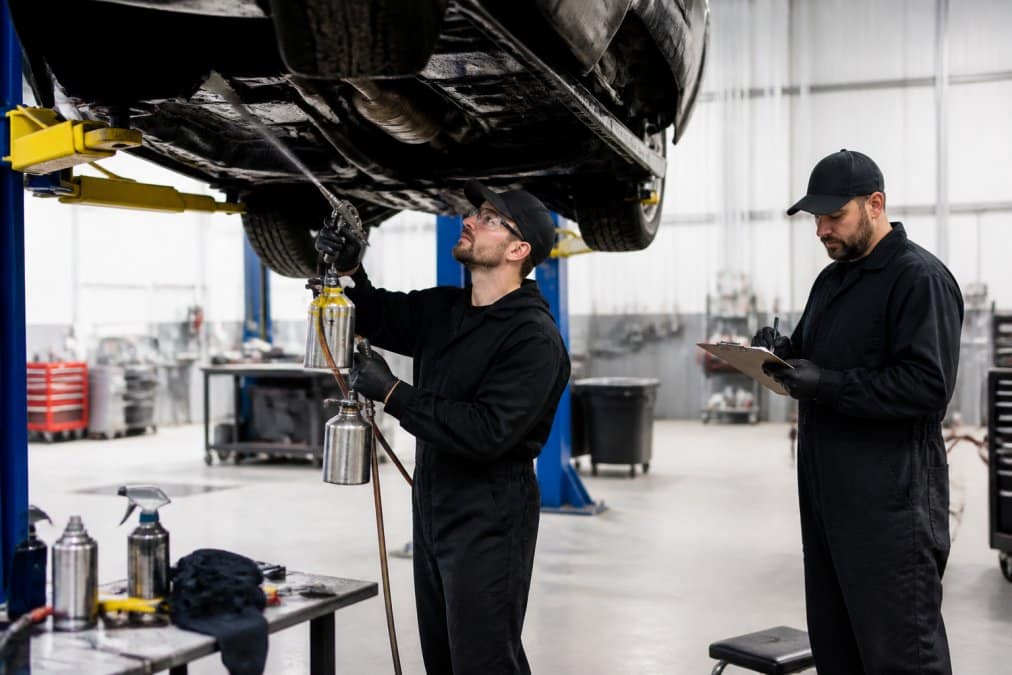
From delivering an estimate to completing and paying for the work, the goal is transparency and communication at every step. Here is the typical flow:
- Estimate. You get a clear scope of work and a quote based on your vehicle type and condition.
- Inspection. A technician inspects the underbody and flags any existing rust before coating.
- Preparation. Surfaces are cleaned and prepped so the coating bonds properly.
- Application. The Waxoyl product is applied to the frame, wheel wells, and hard-to-reach areas.
- Cure and drive. The vehicle is ready to drive shortly after application.
Best Time of Year to Schedule
Late summer and early fall are the busiest window because drivers want protection in place before the first salt brine hits the roads. Booking ahead of that rush gets you a more flexible appointment and leaves time for any rust treatment the inspection uncovers. Undercoating can be applied any time of year, though, and a mid-winter application still protects the vehicle for the rest of the season and beyond.
Fleet and Multi-Vehicle Scheduling
Fleet managers with multiple vehicles should mention the fleet size upfront. Scheduling several vans or trucks at once is routine, and the team can coordinate a drop-off plan that keeps your operation running. Grouping vehicles into one visit also keeps inspection and prep consistent across the fleet.
Book before the first salt brine application of the season, prep the undercarriage the day before, and ask for the written guarantee terms at the time of booking so there are no surprises at pickup.
Frequently Asked Questions
How long does automotive undercoating typically last?
The lifespan of automotive undercoating depends on the product and application quality. A one-time Waxoyl application from a professional provider can include a corrosion guarantee of up to 10 years. Annual inspections help catch any wear early and keep the protective coating performing as intended. DIY spray-on products usually need reapplication every year or two, especially in areas with heavy road salt exposure like Rochester winters.
Is rustproofing necessary for new cars in Rochester?
Factory coatings protect the exterior paint, but they leave the undercarriage and frame largely exposed to road salt and salt brine. In a region where de-icing agents are used heavily from November through March, rustproofing a new car is a practical way to protect your investment. A one-time application of a wax-based product reaches the areas where rust actually starts, extending the serviceable life of the vehicle well beyond the factory coating’s reach.
How does professional wax-based undercoating differ from DIY sprays?
DIY sprays are convenient but often miss the hidden areas where corrosion begins, such as inside frame rails and behind wheel wells. Professional application uses high-pressure spray equipment to reach those spaces and applies a corrosion inhibitor that forms a durable, waxy barrier. The result is a longer-lasting finish with a corrosion guarantee of up to 10 years, compared to DIY products that typically need reapplication every season.
What should I look for when booking a rustproofing service?
Look for a provider with a documented application process, a clear pre-application inspection, and a written corrosion guarantee. Ask what product they use, how long the application takes, and whether you can drive the vehicle immediately afterward. Also confirm they treat the full undercarriage, including frame rails and wheel wells, not just the visible underside. A provider that communicates every step from estimate to completion is a good sign.