Table of Contents
- Is Rustproofing Necessary for New Cars?
- Factory Rust Protection vs. Aftermarket Solutions
- The Benefits of Vehicle Undercoating
- How Long Does Rustproofing Last?
- Climate and Geography: When Rustproofing Matters Most
- Types of Rustproofing: Sprays, Electronic, and Undercoating
- Resale Value and Long-Term Vehicle Ownership
- Conclusion
- Frequently Asked Questions
Last Updated: September 30, 2026
Is Rustproofing Necessary for New Cars?
Whether is rustproofing necessary for new cars depends on your climate and ownership timeline. Factory coatings provide baseline protection but often fall short in harsh climates where road salt, moisture, and temperature swings accelerate corrosion within a few years.
The question is whether factory improvement is sufficient for your situation. We’ve worked with many vehicle owners who discovered surface rust and corrosion damage within three to five years despite factory coatings. The difference between protected and unprotected vehicles becomes visible in resale value and long-term serviceability.
This guide covers what factory rust protection actually does, when aftermarket rustproofing makes financial sense, and how to evaluate whether you need it based on your climate and ownership timeline.
Factory Rust Protection vs. Aftermarket Solutions
Modern vehicles come with factory rust protection using multiple paint layers, galvanized steel, and cavity sealants. However, factory protection has built-in limitations.
Factory coatings are engineered to meet warranty requirements and cost targets, protecting against corrosion for five to seven years. After that window, road salt, calcium chloride, and moisture penetrate seams and joints where factory coatings are thinner or absent.
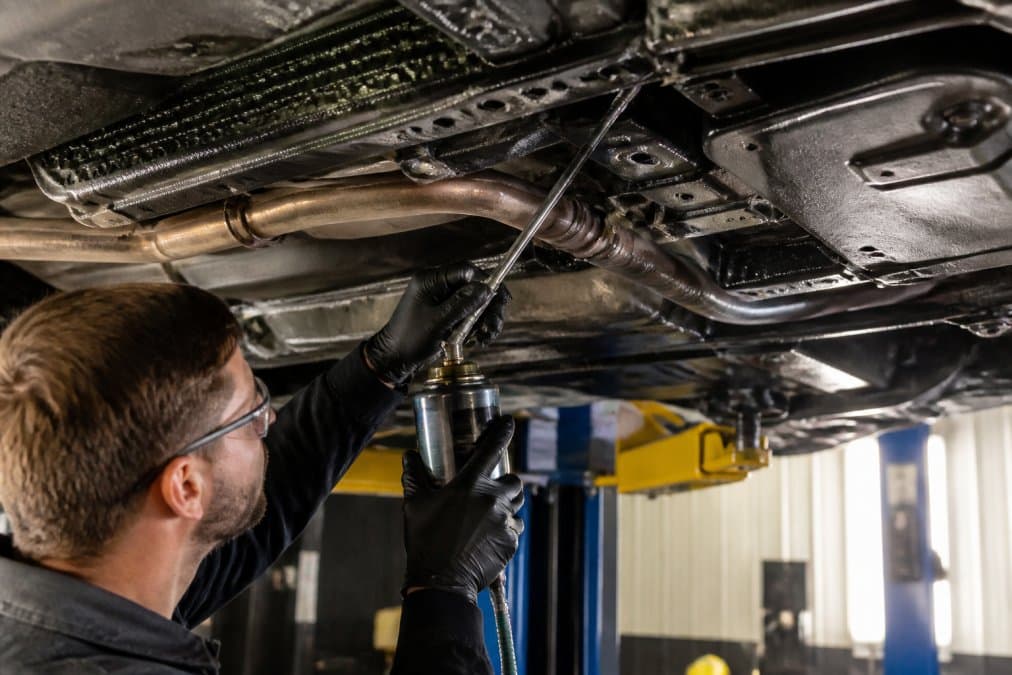
Professional undercoating treatments like Waxoyl create a thicker, more durable barrier lasting significantly longer than factory protection. Applied after manufacturing, technicians reach areas assembly-line robots cannot access, offering deeper penetration into cavities and joints where corrosion initiates.
The choice between relying on factory protection and adding aftermarket rustproofing comes down to your vehicle’s exposure level and your ownership timeline.
The Benefits of Vehicle Undercoating
Professional undercoating extends serviceable life by maintaining structural integrity, which impacts safety, handling, and resale value. Corroded frames weaken suspension performance and emergency response.
Rust damage depreciates value faster than almost any other wear. A vehicle with visible corrosion sells for substantially less than an identical model without it, even if purely cosmetic.
Undercoating reduces maintenance costs by preventing premature failure of brake lines, suspension fasteners, and structural welds, meaning fewer emergency repairs.
For fleet operators, extending vehicle life by two to three years through corrosion protection often pays for treatment many times over through avoided replacement costs.
How Long Does Rustproofing Last?
Rustproofing lifespan depends on treatment type, application quality, and exposure environment.
Factory Rust Protection Lifespan
Factory rust protection typically lasts five to seven years. Coatings are thinner in hard-to-reach areas and cannot achieve the penetration depth of professional application. After this window, UV exposure, thermal cycling, and moisture weaken adhesion, allowing salt to initiate corrosion from inside out.
Spray Treatment Durability
Spray coatings remain effective for 12 months under normal conditions, declining to 6-9 months in harsh environments. They dry out and crack under vehicle movement, allowing moisture and salt to penetrate behind the coating, which is why annual reapplication is necessary.
Professional Undercoating Longevity
Professional undercoating offers ten years or more of protection. Quality products remain flexible rather than drying and cracking, allowing the coating to move with the chassis without stress cracks. Professional application penetrates deeper into cavities where corrosion initiates.
Duration depends on driving conditions and application quality. In high-salt environments, professional undercoating remains effective for 8-10 years versus factory protection degrading within 5-7 years.
Application quality is critical. Undercoating applied to improperly prepared surfaces may trap moisture and accelerate corrosion. Professional application requires thorough cleaning, proper drying, and correct technique to ensure full coverage.
Environmental Factors Affecting Durability
Climate and driving patterns affect treatment longevity. Arid climates experience slower degradation due to minimal moisture. Regions with aggressive de-icing or coastal salt spray experience accelerated degradation.
Garage storage versus outdoor parking also affects lifespan. Vehicles parked indoors experience less UV exposure and moisture cycling, which slows coating degradation. Vehicles parked outdoors year-round experience faster breakdown of protective coatings due to thermal cycling (expansion and contraction from temperature swings) and constant moisture exposure.
The One-Time Application Advantage
The extended lifespan of professional undercoating eliminates the annual ritual of scheduling treatments and the cumulative cost of repeated applications. Over a ten-year ownership period, a vehicle owner choosing annual spray treatments might spend significantly more in total treatment costs than a single professional undercoating application, while receiving less consistent protection. This cost-benefit calculation shifts even more favorably toward professional undercoating for owners planning to keep vehicles beyond seven years.
Climate and Geography: When Rustproofing Matters Most
Geography is the primary driver of rustproofing necessity. Regions that use road salt and calcium chloride for winter de-icing create the most aggressive corrosion environment. Vehicles in these areas face constant exposure to corrosive chemicals that eat through protective coatings and accelerate oxidation on exposed metal.
Coastal areas present a different but equally serious challenge. Salt spray from ocean air penetrates far inland, depositing sodium chloride on vehicles even if they’re not regularly driven on salted roads. Vehicles parked near the coast experience accelerated corrosion compared to inland vehicles in the same state.
Arid and desert climates present the least corrosion risk. Low humidity and minimal road salt mean vehicles can go years with minimal rust development. In these regions, factory rust protection alone is often sufficient for the typical ownership period.
Temperate climates with moderate humidity and occasional winter weather fall in the middle. Vehicles in these areas may not need aggressive rustproofing if they’re garaged regularly and washed frequently to remove salt residue. However, if a vehicle is parked outdoors year-round or driven regularly on salted roads, even temperate regions benefit from professional protection.
The most compelling case for rustproofing exists in the transition zones, regions where winter brings salt application but summers are warm and humid. These environments create ideal conditions for corrosion: salt deposits in winter, moisture activation in spring and summer, and freeze-thaw cycles that open cracks in protective coatings.
Types of Rustproofing: Sprays, Electronic, and Undercoating
Three primary rustproofing approaches exist in the aftermarket: spray treatments, electronic rust modules, and professional undercoating. Each operates on different principles and delivers measurably different protection profiles.
Spray Rustproofing Treatments
Spray rustproofing is applied annually or semi-annually by spraying protective compounds into cavities and onto undercarriage surfaces. These products typically contain oils, waxes, or lanolin-based formulations that create a thin barrier against moisture and salt. The advantage is accessibility, many service centers and dealerships offer spray treatments, and application takes 30 to 60 minutes. The disadvantage is durability: spray coatings dry out, crack, and lose adhesion within 12 months, especially in harsh climates where temperature swings and road vibration accelerate degradation. The cumulative cost of annual treatments over time can exceed the cost of a single professional undercoating application, while providing less consistent protection.
Electronic Rust Protection Modules
Electronic rust protection uses a small module installed on the vehicle that generates a weak electrical current (typically milliamps) designed to prevent oxidation on metal surfaces. The theoretical mechanism is cathodic protection: the electrical field shifts the electrochemical potential of metal, inhibiting the oxidation reaction that creates rust.
However, the efficacy of electronic rust modules remains scientifically contested. Laboratory studies under controlled conditions have shown modest corrosion reduction, but real-world performance data is limited and inconsistent. The National Association of Corrosion Engineers (NACE) has not issued a consensus standard endorsing electronic rust modules for vehicle applications, and independent testing by automotive research organizations has produced mixed results. Some studies suggest protection in static conditions, but vehicles experience constant vibration, moisture cycling, and salt exposure that may overwhelm the electrical field’s protective effect. Additionally, the electrical current only protects metal surfaces in direct contact with the vehicle’s chassis, it does not penetrate into cavities or protect paint and rubber components where corrosion often initiates.
Electronic modules may be less expensive than professional undercoating but also provide less proven protection. Most automotive professionals recommend them only as a supplementary measure, not as a primary rust defense strategy.
Professional Undercoating
Professional undercoating involves a single application of a high-performance protective compound, typically wax-based or polymer-based formulations, applied to the entire undercarriage, cavities, and vulnerable joints. The material is sprayed or brushed into crevices where rust typically initiates, then hardens into a flexible, durable barrier that remains pliable as the vehicle ages and experiences temperature fluctuations.
The mechanism is physical and chemical: the coating creates a moisture and salt barrier while the formulation’s flexibility allows it to move with the vehicle’s chassis without cracking.
Comparative Effectiveness
Resale Value and Long-Term Vehicle Ownership
Rust and corrosion damage directly impact resale value. A vehicle with visible rust, even if it’s purely cosmetic, sells for less than an identical model without corrosion. Buyers perceive rust as a sign of neglect or environmental damage, which makes them question what other maintenance issues might be hidden.
Conclusion
Rustproofing is necessary for new cars in most situations, particularly if you live in a region with road salt, coastal salt spray, or plan to keep your vehicle longer than five to seven years. Factory rust protection provides a baseline, but it’s engineered to meet warranty requirements, not to maximize longevity. Professional undercoating addresses this gap by delivering protection that lasts a decade or more with a single application.
Frequently Asked Questions
Is it worth rustproofing a new car?
Whether rustproofing is worth it depends on your climate, how long you plan to keep the vehicle, and your exposure to road salt or moisture. In areas with harsh winters or coastal environments, aftermarket rustproofing can significantly extend your vehicle’s serviceable life and protect your investment. Even new cars benefit from additional corrosion resistance beyond factory coatings, especially if you drive regularly in conditions that accelerate oxidation.
How long does professional rustproofing last?
High-quality professional rustproofing applications can provide protection for 10 years or more, depending on the product used and environmental conditions. One-time applications of cavity wax and undercoating create a durable moisture barrier that resists road salt and calcium chloride exposure. Unlike annual treatments, professional-grade products offer extended frame integrity protection without repeated applications, making them a practical long-term solution for vehicle owners.
Does factory undercoating provide enough protection?
Factory coatings offer basic corrosion resistance but are often thinner and less comprehensive than aftermarket protection. Modern vehicles use galvanized steel and improved paint protection, yet factory warranties typically cover rust perforation only after several years. In salt-heavy environments or for vehicles kept long-term, factory protection alone may not prevent surface rust or structural corrosion in vulnerable areas like the frame and chassis.
What areas of a vehicle need undercoating protection?
Professional undercoating treats the frame, chassis, suspension components, wheel wells, and cavity areas where moisture accumulates. These spots are most vulnerable to road salt and oxidation because they’re exposed to spray and difficult to clean. Proper application ensures a protective sealant reaches all crevices where corrosion typically begins, providing comprehensive coverage beyond what DIY methods can achieve.